Journaling for Neurodivergent Minds: A Guide for People Who Are "Bad at Journaling”
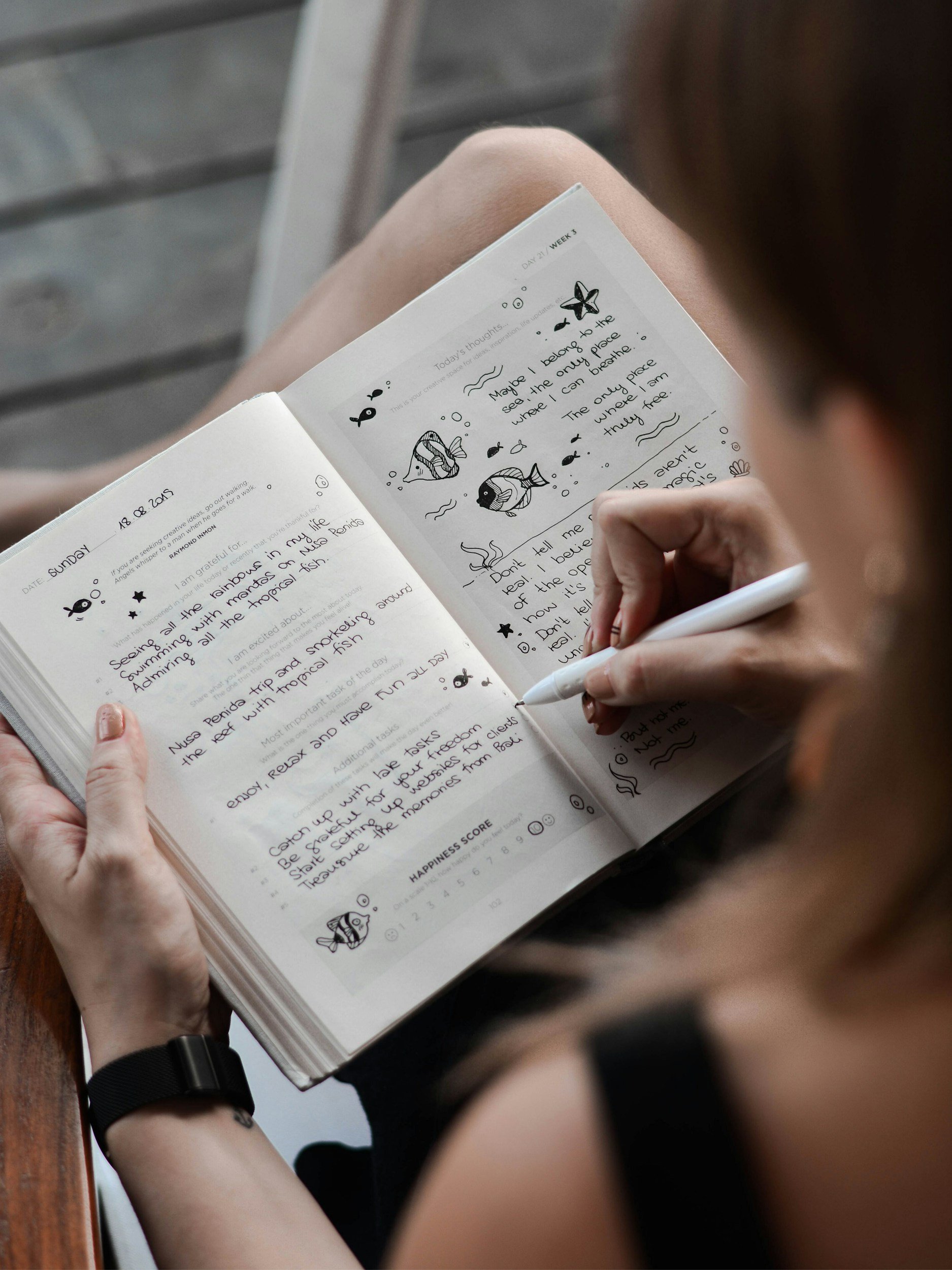
If you've ever bought a beautiful journal, written three entries, and then let it sit on your nightstand collecting dust while you quietly catalog it as more proof that you're "bad at this" — I want you to know two things right away. First, you are nowhere near alone. Second, you were probably never bad at journaling. You were handed the wrong instructions.
I'm a therapist who works with a lot of ADHD, Autistic, and AuDHD folks — many of them high-achieving, many of them perfectionistic — and I hear a version of this same story constantly: "I know I should journal. I've tried. I can't stick with it. And honestly, when I do write, I overthink every sentence and end up more activated than when I started." I also happen to be one of these people myself. I'm an ADHDer with a well-worn perfectionist streak, and I have started more journals than I can count. So this post comes from both sides of the room — the therapist's chair and the client's chair.
What I want to offer here isn't "just journal more." It's a rethink of what journaling is allowed to look like, so that it actually works with your brain instead of against it.
Why Journaling Is Genuinely Harder for Neurodivergent Brains
Let's start by naming what's actually going on, because I think a lot of self-blame in this area comes from not realizing there's a real, structural reason journaling feels so hard.
The blank page is an executive function nightmare. A blank page has no structure, no prompts, no clear stopping point, and no obvious "right" way to fill it. For ADHD brains, that kind of unstructured, self-directed task is exactly the type of task executive function struggles most with — not because you lack discipline, but because initiation, sustained attention, and organization of ideas are the very skills that are wired differently. A blank page asks you to generate your own structure from nothing, and that is genuinely one of the more demanding asks you can make of an ADHD brain.
Perfectionism turns a coping tool into a performance. So many of the people I work with are high-achieving and perfectionistic — often as a direct adaptation to years of being told they were "too much," disorganized, or not trying hard enough. Journaling should be a private, low-stakes space, but perfectionism doesn't know how to leave a room empty of standards. So the journal becomes just one more place where things have to be accurate, well-organized, complete, in nice handwriting, in full sentences that "sound right." The pressure to do it "correctly" makes the one tool that's supposed to relieve pressure into another source of it.
Handwriting and visual organization can be its own barrier. For a lot of Autistic and ADHD folks, especially those with dysgraphia or fine motor differences, the physical act of handwriting is uncomfortable or effortful, and the visual result — messy lines, crossed-out words, uneven spacing — can be its own trigger for perfectionistic shame. If your journal page doesn't look "right," it's hard to feel settled by it, even if the writing itself did something good for you.
The "getting it out but not resolved" problem. This one is huge and I want to spend a minute on it because I think it's under-talked-about. Journaling can create relief from expressing a feeling, while leaving you with zero resolution to the actual uncomfortable feeling or uncertain situation underneath it. You write out the anxiety, you feel a little lighter for having named it, and then you close the notebook and the uncertainty is still just... there. For a brain that craves closure, certainty, or a clear next step (hello, ADHD and Autistic traits both), that can feel worse than not writing at all — like you opened a door and didn't close it.
If any of this is you: it's normal, it's common, and it doesn't mean journaling isn't for you. It means the standard advice — "just write for ten minutes every day about your feelings" — was designed with a different kind of brain in mind. You get to build your own version.
A Quick Reframe Before We Get Into Methods
Before the list of options, one mindset shift that I think matters more than any specific technique: journaling is not a writing assignment. It's a form of processing, and processing can take almost any shape. There is no teacher grading this. No one is checking your grammar, your handwriting, or whether your thoughts arrived in a logical order. The only job of a journal entry is to have done something useful for you in the moment you made it — and "useful" can mean "I feel 5% calmer," not "I solved the problem."
It can also help to explicitly give yourself permission that the entry does not need to resolve anything. Some entries are just for getting something out of your head and onto a page so it stops looping. That's a complete, successful entry, even if the last line is a question mark instead of an answer. If the "no resolution" feeling is a recurring problem for you, it's worth naming that out loud in the entry itself — literally writing "I don't need to solve this right now, I just need it out of my head" — and, if you're in therapy, bringing the unresolved threads in to work through with your therapist. Journaling and therapy can be a great one-two combination: the journal surfaces it, the therapy session helps metabolize it.
Different Ways to Journal
Here's the heart of why I created this post. So often I’ll work with clients to create a menu of different approaches. None of these are the "right” way to journal. Think of this less like a recipe and more like a box of tools where you're allowed to grab whichever one your hand reaches for that day. Feel free to pick what fits, mix and match, and change your mind whenever.
1. Bullet points and incomplete sentences
This might be the single most useful reframe for perfectionistic ADHD and Autistic journalers: you do not have to write in full sentences. A journal entry can be a list. It can be fragments. It can look like:
work meeting — annoyed, not sure why
keep thinking about the thing mom said
tired. good tired or bad tired?
want to text her back but scared
That's it. That's a real, valid, useful entry. Bullet points bypass the part of your brain that wants to craft a coherent narrative and let you just get the raw material down. For a lot of my clients, giving explicit permission for "this doesn't have to be sentences" is the single biggest unlock for actually being able to start.
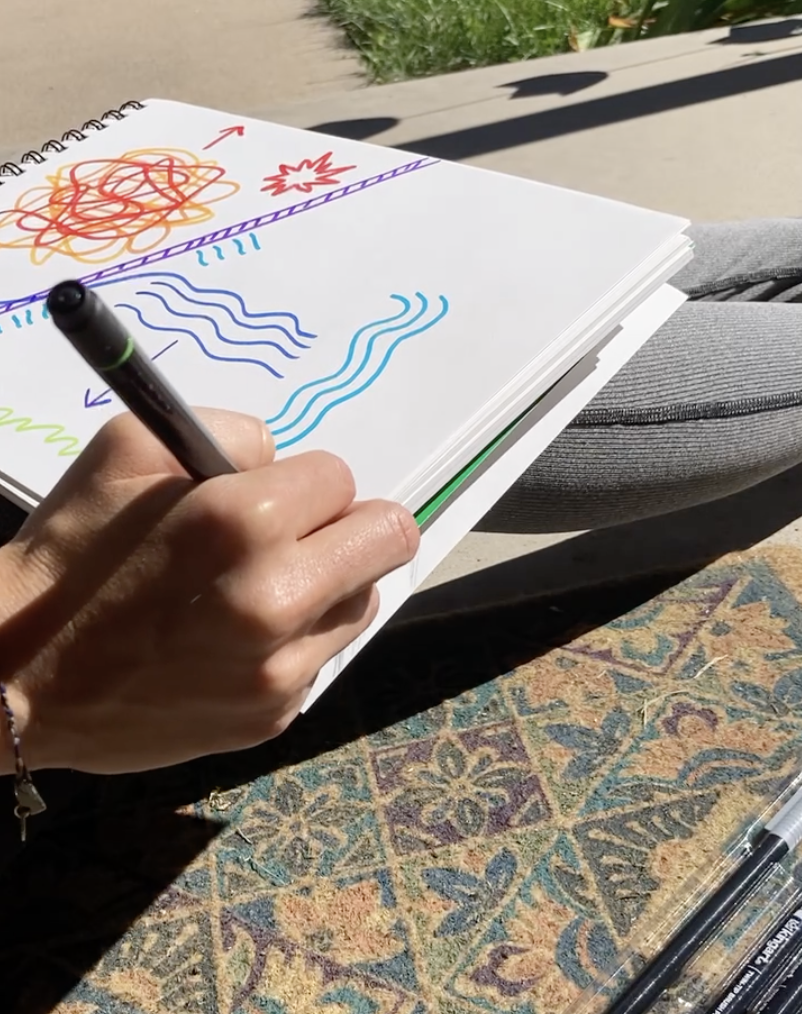
2. Art and visual journaling — shapes, colors, lines (my personal favorite)
This is genuinely my own go-to, and I recommend it frequesntly to fellow perfectionistss as a form of both exposure and way to activate the more creative, emotional side of th brain. Instead of words, you use color, shape, line weight, and placement on the page to represent what's going on inside you. A tight, jagged scribble in red in the corner of the page might be anxiety. A loose, spread-out blue wash might be relief. You don't need any art skill or training. This isn't about making something that looks good, it's about externalizing a feeling that might not have good words yet anyway.
This approach is especially powerful for Autistic and ADHD folks because it sidesteps two big obstacles at once: it doesn't demand handwriting to look "neat," and it doesn't demand that your internal experience get translated into tidy, accurate language before you're allowed to express it. Sometimes a feeling is a shape before it's a sentence, and that's allowed to be enough.
3. Stream of consciousness
Set a timer (even just two or three minutes) and write continuously without stopping, without editing, without lifting the pen or backspacing. If you don't know what to write, you write "I don't know what to write" until something else shows up. The rule is simple: don't stop, don't fix, don't judge. This is one of the most direct antidotes to perfectionism because the format itself makes "getting it right" structurally impossible — there's no time to polish a sentence you're not allowed to stop and rewrite. A lot of my clients who freeze up trying to write "properly" do much better with a timer and a rule that says editing isn't even an option.
4. Writing to your parts (an IFS-informed approach)
If you're doing Internal Family Systems (IFS) work in therapy, journaling can be a natural extension of that between sessions. Instead of writing generally about your day, you write to or from a specific part of you — the part that's anxious about the email you haven't sent, the perfectionist part, the part that's exhausted from masking all day, the young part that still feels like it has to earn love through achievement.
Some ways to structure this:
Dialogue format — write a back-and-forth conversation between you (or your Self) and the part, almost like a script. "Perfectionist part: if I don't get this exactly right, they'll think you're I’m good enough. Me: I hear that you're scared. What are you afraid will happen?"
Letter to a part — write directly to the part as if it's a person you're getting to know: "Dear part that panics after every social interaction with a new person..."
Letter from a part — flip it, and let the part write to you.
Check-in questions — What does this part want me to know today? What is it afraid would happen if it stopped doing its job? How old does this part feel? What does it need from me right now?
A prompt list can genuinely help here, because parts work benefits from a bit of scaffolding rather than a totally open page. A short rotating list — pick one, answer briefly, done — takes the pressure off having to think of the "right" question yourself every time.
5. Drawing out parts and conflict — visual IFS and visual conflict mapping
You can combine the art-journal approach above with parts work directly. Draw your parts as shapes, colors, or simple figures. Give a part a scribble-shape if that's truer to how it feels than a face would be. For interpersonal conflict (i.e., a hard conversation with a partner, a tense exchange with a coworker) try drawing two simple figures with talk bubbles, and write what each person actually said in one bubble and what you wished you'd said (or what you think they were really feeling) in a second bubble above it. This gives you distance from a charged interaction, turns it into something you can look at rather than just relive, and it takes pressure off finding the "exact right words" in real time, since you get to sort it out visually and asynchronously instead.
6. Tracker-style journaling
Sometimes the most useful entry isn't a narrative at all — it's data. A simple table, checklist, or scale where you note the day's mood, sleep, energy, any symptoms, or a 1–10 rating of a few key feelings, with maybe one or two words of context. You're not trying to process anything in the moment; you're just capturing the raw material so you and your therapist can look for patterns later.
This style tends to land really well for people who feel overwhelmed by open-ended reflection but are perfectly comfortable with structured, checkbox-style formats (a lot of my ADHD and Autistic clients light up at this one specifically because it removes the "what do I even say" problem entirely). It's also genuinely clinically useful — tracking patterns over weeks can surface things like "oh, I always crash two days after a social event" that are hard to see in the moment.
7. Apps and digital tools
Paper isn't the only option, and for a lot of people it's not even the best one. There are dedicated journaling apps (some with prompts built in, some that let you voice-record instead of type, some built specifically for mood tracking), and there's also just the Notes app on your phone, which counts every bit as much as a leather-bound notebook. If you're someone who always has your phone in your hand anyway, the lowest-friction option might genuinely be the best one — the "best" journal is the one you'll actually use.
Figuring Out What Format Actually Works for You
Since there's no single right way to do this, it's worth treating your own preferences like data worth collecting. A few questions to sit with:
Paper or digital? Some people find paper more grounding and less distracting (no notifications pulling you away mid-thought); others find that the friction of finding a pen and notebook is exactly the barrier that keeps them from ever starting, and a phone removes that friction entirely. Neither is more "legitimate" than the other.
If paper — lined, dotted, or blank? This is a bigger deal than it sounds. Lined paper can feel like a rulebook for people who already feel boxed in by rules everywhere else. Dotted paper offers just enough structure for those who want a littleguidance without full lines. Blank paper offers total freedom but can also feel more intimidating if structure usually helps you get started. Try more than one and notice which makes your shoulders drop a little when you open to the page.
Notes app, or a dedicated journaling app? A general notes app is low-pressure and always at hand. A dedicated app might offer helpful scaffolding like prompts, mood tracking, or reminders — good if you want a bit more structure, potentially overwhelming if you're prompt-fatigued from a full day of decisions already.
Time of day and place. Some people process best first thing in the morning before the day's noise sets in; others need to unload at night to be able to sleep; others do best journaling in the middle of the day as a reset. Some people need total quiet, others actually focus better with background noise or in a public-ish space like a coffee shop. There's no universal right answer — pay attention to when you naturally have thoughts you wish you could get down, and try building a habit around that window instead of an arbitrary "everyone journals before bed" rule.
None of these preferences are fixed forever, either. What works this year might not work next year, and that's not failure, that's just you changing.
If Handwriting or Visual "Messiness” of Journaling Stresses You Out
For clients (and honestly, for me too, some days) who get tripped up by wanting the page to look a certain way, a few small, low-stakes exposures can help build tolerance:
Practice writing on a blank page with no lines, and let the words drift wherever they land. Not in a straight row, at an angle, wherever your hand wants to go. Notice the urge to "fix" it, and practice not fixing it.
Practice incomplete sentences on purpose, even when you feel the pull to finish them properly.
Practice crossing things out instead of erasing or starting over. Let a mistake just sit there on the page, crossed out and visible, instead of needing it erased into nonexistence.
Try highlighting, underlining, or circling words instead of writing more words — sometimes marking up three words that matter is more honest and more useful than a full paragraph explaining them.
Bring in different colors for different feelings or different parts, without worrying about whether the color-coding is "consistent" or "correct." There's no answer key.
If handwriting itself is the friction point, try leaning all the way into the visual/art journal approach above. Let shape, color, and line carry the entry instead of words at all. For a lot of people, this doesn't just work around the handwriting stress, it actually resolves it, because there's no "neat" standard to fail to meet in the first place.
Think of these like small reps at a gym for tolerating imperfection — you're not trying to become a different person overnight, you're just building a little more flexibility each time.
Prompts to Use When You Don't Know Where to Start A Journal Entry
For some people, that act of getting started can also come from not knowing what to write about. Below is a short prompt list to keep somewhere handy for the days the blank page feels like too much:
What's taking up the most space in my head right now?
What am I avoiding thinking about today?
If this feeling were a color/shape/weather pattern, what would it be?
What does [name a part] want me to know today?
What's one thing I did today that I'd tell a friend about, good or bad?
What am I afraid will happen if I don't have this figured out yet?
What would I say to a friend who was in my exact situation right now?
What's one sentence — just one — that's true right now?
You never have to use all of these, or any of them, in order, or completely. Pick one. Answer with three words if that's what shows up. Done.
Final Thoughts on Jounraling
If you take one thing from this post, I hope it's this: the version of journaling that gets marketed to you… cursive in a leather notebook, three tidy paragraphs a day, deep insight arriving on schedule… was never the “correct” way to journal. It's one style among many, and it happens to be a style that fits some brains and genuinely fights against others.
I say this as someone who has a drawer full of "failed" journals and also a much messier, much more honest practice of scribbles, half-sentences, and colored shapes that actually works for me. My clients teach me new variations on this constantly, and one of my favorite parts of this work is watching someone realize that the thing they thought they were bad at was actually just the wrong shape for them — and that once they found their shape, it turned out they'd been capable of this all along.
Whatever you land onbullet points, a color scrawled across a page, a tracker with three checkboxes, a dialogue with a scared part of yourself — if it helped you get something out of your head today, you did it right.
If you’re living in Colorado and looking for support building a journaling or self-reflection practice that actually works with your neurodivergent brain, or want to bring what comes up in your journal into therapy, I'd love to connect! Reach out anytime to book a free consultation.
